

Concrete Walkway Installation Contractor in Mission Hills, CA
Thank you for contacting us.
We’ll get back to you as soon as possible.
We got it.
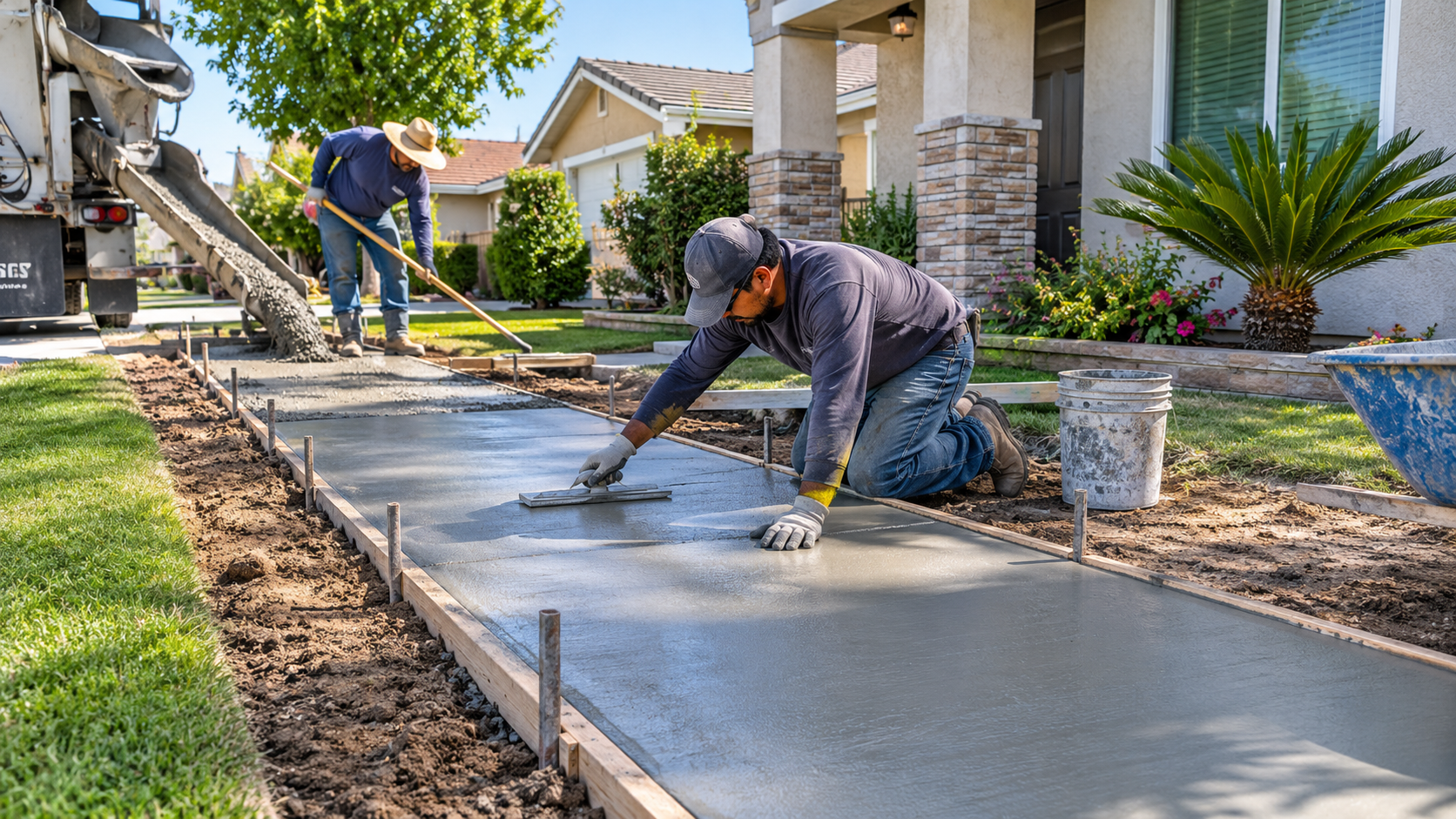
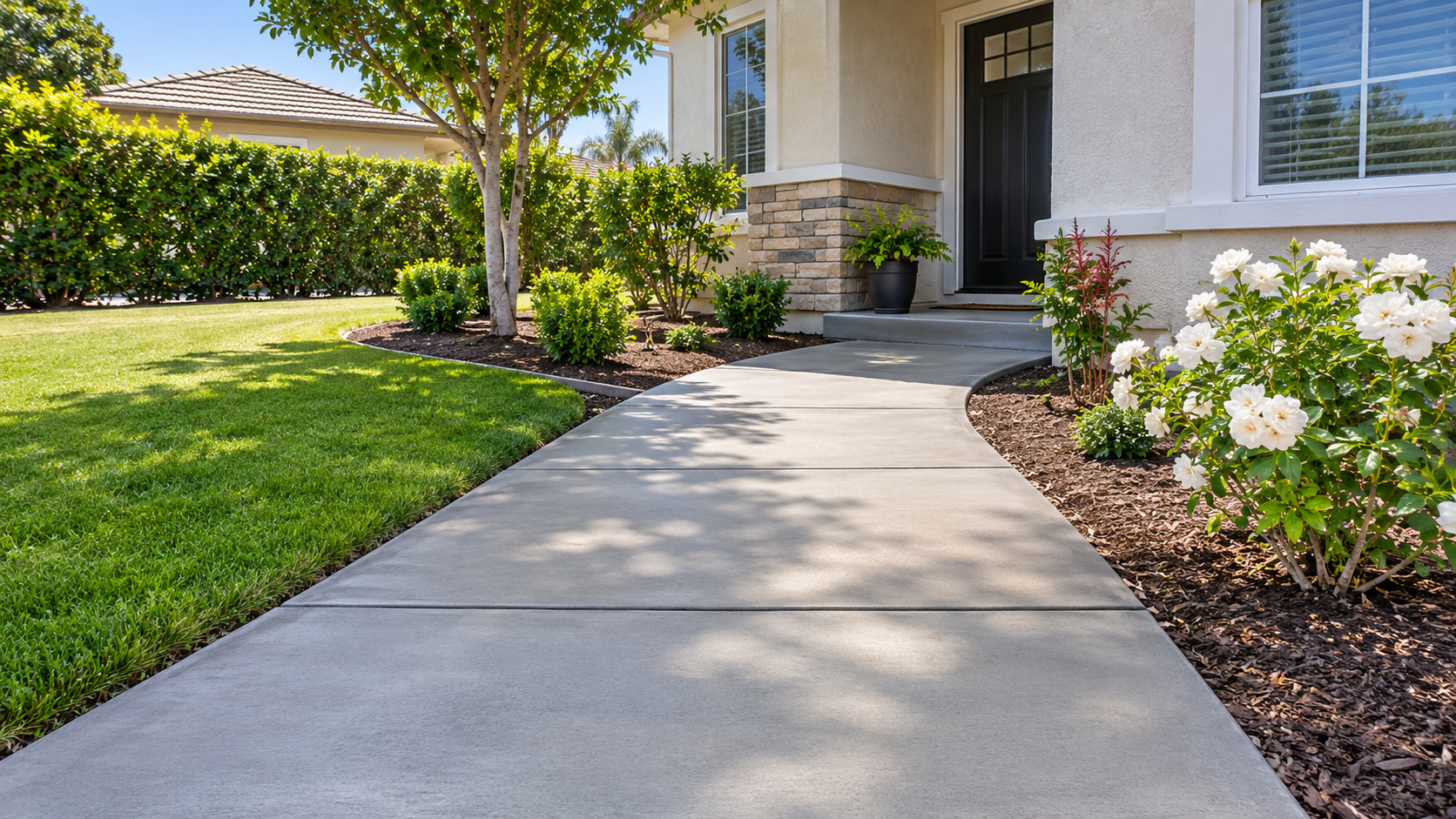
Everything starts with a walk around the yard, because a painted line on the ground tells us more then any drawing does. We dig out about 7 inches, compact the native soil, and put down 3 inches of class 2 base rock. Forms are set with a 2 percent cross slope so water runs off toward the lawn or gutter and not at your front door. The mix is 3,000 PSI, poured 4 inches thick with #3 rebar or wire mesh, and control joints get cut every 4 to 5 feet. Last comes the broom finish and a curing compound.
How a Walkway Gets Built From Bare Dirt to Broom Finish
Back in September we tore out a cracked, heaving entry walk at a 1960s ranch house off Lassen Street, near Woodman Avenue. The old path was lifted almost 2 inches by a big elm root and the homeowner had already tripped twice. We worked around the root with his arborist, laid a fresh 52 foot by 4 foot walkway (208 square feet), and poured it at 4 inches thick with a light broom finish. Total came to $2,650, finished in two days, and he told us it was the first time the path felt flat since he moved in.
A Recent Entry Walk Off Lassen Street Shows How We Handle Root Damage
Folks around here pick us because we show up when we say we will, and thats rarer than it should be. Our shop is in North Hills, right next door, so a crew can get to a job near San Fernando Mission Boulevard or Brand Boulevard in about ten minutes. One foreman stays on your project from layout to the final sweep, no handing it off to random subs. A Dependable Concrete Walkway Installation Contractor in Mission Hills, CA should also pick up the phone after the check clears. We tell you what soil and tree roots will do before the pour.
Why Mission Hills Homeowners Keep Calling Us Back
Most walkway jobs we quote around Mission Hills land between $9 and $15 per square foot, and where you fall in that range depends on whats under the old path. A plain broom finish run, say 40 feet by 4 feet, is 160 square feet and usually pencils out to $1,500 to $2,400. Demo and haul-away adds about $1 to $2 per square foot. Color or a stamped pattern runs $4 to $10 more. Jobs under 100 square feet carry a minimum near $1,500, mostly because of the short-load fee from the plant. Everything gets listed line by line.
Walkway Pricing Around Mission Hills Runs $9 to $15 a Square Foot
Walkway Permits, Right-of-Way Rules, and Concrete Regulations in Mission Hills
Does a Concrete Walkway Need a Building Permit in Mission Hills?
Usually not, but it depends on the height. Under the California Building Code, walks and driveways that sit no more than 30 inches above the adjacent grade, aren’t over a basement, and aren’t part of an accessible route are exempt from a LADBS building permit. Exempt only means no permit it doesn’t mean no rules. We check each address before we quote, and if a path climbs a slope or ties into a new ADU, we call LADBS first.
Bureau of Engineering Permits for Sidewalk, Parkway, and Driveway Apron Work
Work that touches the city’s right-of-way, meaning the sidewalk, parkway strip, or driveway apron, goes through the Bureau of Engineering instead of LADBS. That’s a Class A permit, and fees are charged by the square foot. Fill behind the curb needs 90 percent compaction and 95 percent at the curb. If a street tree is in the way, Urban Forestry has to sign off first, so we line that up early and book the inspection before the pour.
Property Lines, Zoning, and Easements Before the Forms Go In
Mission Hills sits inside the Mission Hills–Panorama City–North Hills Community Plan area, and a lot of the residential lots here are single-family zoning. Walkways are generally fine in the yard, but we pull the lot up on ZIMAS, confirm property lines, and look for recorded easements before staking anything. If theres an HOA involved, we ask for their rules too. Nobody wants a neighbor’s fence line or a utility easement turning into a tear-out.
Calling 811 and Marking Utilities Before Any Digging
California law says we have to contact DigAlert (811) at least two working days before we dig, so every walkway job starts with a ticket and marked lines. In Mission Hills that usually means water service lines, gas, and sometimes old sewer laterals running closer to the surface than you’d expect. We also keep concrete off water meter boxes, cleanouts, and gas shutoffs so crews can still get to them. Its slower to wait for the marks, but cutting a line costs way more.
Accessible Routes, Drainage, and Final Inspections
If a walkway is part of an accessible route, like a path to an ADU or a multi-unit building, the California Building Code wants at least 36 inches of clear width and a cross slope of 2 percent or less, and a permit may be needed. A Dependable Concrete Walkway Installation Contractor in Mission Hills, CA should also keep runoff on your own property or heading to the street, never onto the neighbors. We schedule every required inspection before the truck gets ordered.
Mission Hills Walkway Concrete FAQs: Heat, Soil, Rain, and Roots
How hot is too hot to pour a walkway in Mission Hills?
Summer highs in this part of the Valley often push into the upper 90s and sometimes past 100, and Santa Ana winds dry out fresh concrete fast. When it’s over about 90 degrees we schedule pours for early morning, use a retarder in the mix, and mist and cover the surface right after finishing. Skipping that is how you end up with plastic shrinkage cracks before the first day is even over.
Will the soil here make my new walkway crack?
It can, if the base is rushed. Mission Hills sits near the foothills at roughly 913 feet, and soils change block to block, with some lots holding clay that swells when wet and shrinks when dry. We compact the subgrade, add 3 inches of class 2 base, and cut control joints so any movement happens in a straight line instead of a random crack across the middle. Drainage away from the slab matters just as much.
What should I do about tree roots lifting my old path?
Mature street trees are all over Mission Hills, and roots love the moisture under a walkway. Before demo we look at which roots are structural, since cutting the wrong ones can hurt the tree or drop it. Parkway trees are controlled by the city, so Urban Forestry may need to be involved. Sometimes the fix is simply curving the path a foot or two, or going thicker with rebar over the root zone.
Can a walkway be poured during the rainy season?
Yes, between storms. Most of our rain falls from November through March, roughly 15 to 18 inches in a normal year, and we don’t pour if heavy rain is forecast within the next 24 hours. Winter nights rarely get cold enough to freeze concrete here, which helps. We keep plastic sheeting on the truck, and if a surprise shower hits we cover the job quick so the surface doesn’t wash out.
How do you handle a sloped front yard on a hillside street?
Slope changes the whole plan. We try to keep the running slope of the walkway at 5 percent or less, which feels like level ground to most people. Steeper than that, we break it up with steps (risers around 7 inches) or switch to a ramp with a handrail. Either way we use a medium broom finish for grip, because nobody wants to slip on their own front path in wet weather.